


Manufacturing Automation Is Moving to “Physical AI”
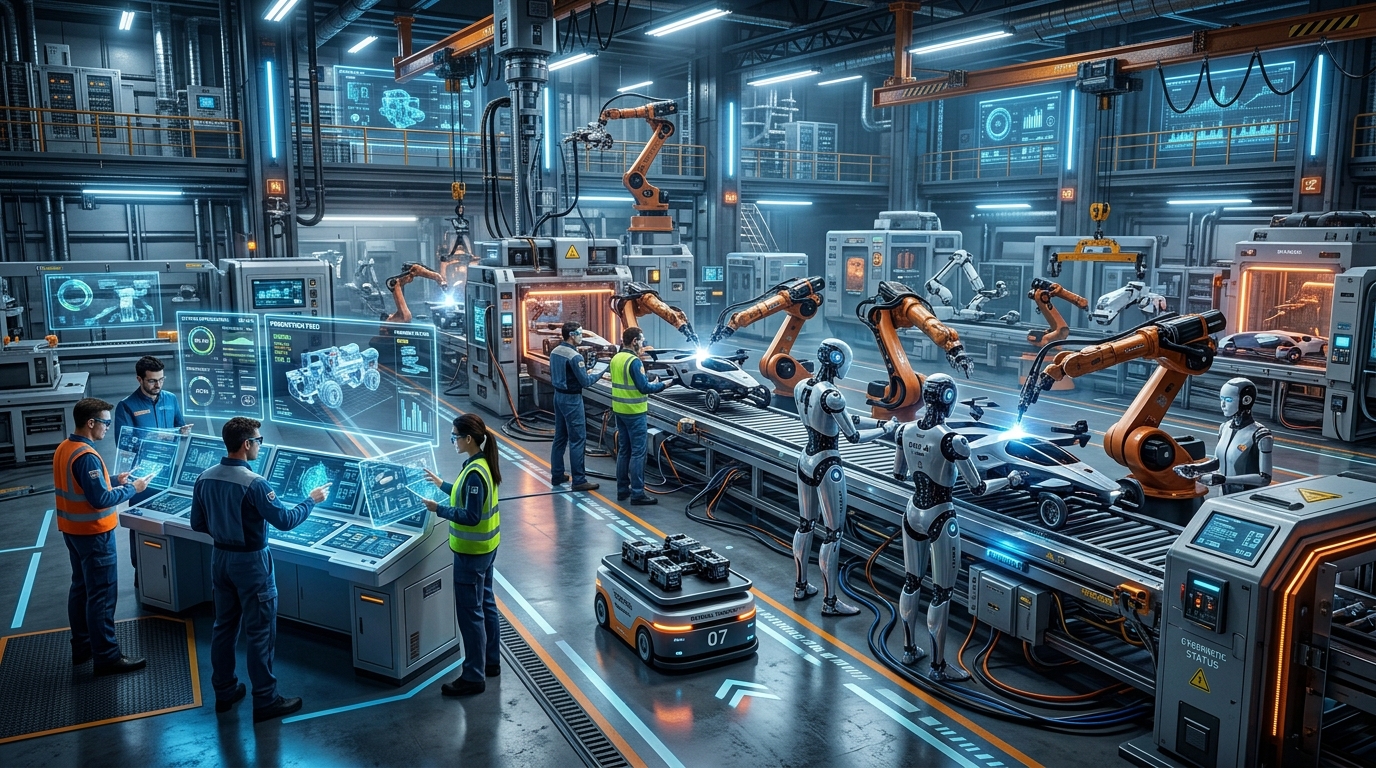
For decades, manufacturing automation focused on one core objective: efficiency. Factories invested heavily in machinery, robotics, conveyor systems, and software that could increase output while reducing human labor. Traditional industrial automation transformed global production and helped companies scale operations faster than ever before.
But manufacturing in 2026 is facing an entirely different environment.
Global industries are now dealing with:
supply chain instability,
labor shortages,
rising operational costs,
geopolitical disruptions,
energy uncertainty,
customer demand volatility,
and increasing pressure for sustainability.
In response, manufacturers are realizing that traditional automation is no longer enough.
Modern factories need systems that are not only automated but also intelligent, adaptive, predictive, and autonomous.
This is where Physical AI is beginning to redefine the future of industrial operations.
Physical AI represents the convergence of:
artificial intelligence,
robotics,
industrial IoT,
computer vision,
autonomous systems,
digital twins,
real-time analytics,
and machine learning.
Unlike older automation systems that simply repeat programmed instructions, Physical AI systems can:
interpret environments,
learn from operational behavior,
make decisions,
adapt in real time,
and continuously optimize performance.
This transformation is becoming one of the largest technological shifts in manufacturing history.
Understanding the Shift From Traditional Automation to Physical AI
Traditional automation systems were designed around predefined logic.
Machines performed:
repetitive tasks,
fixed production sequences,
and rule-based operations.
These systems were extremely effective for mass production environments where processes rarely changed.
However, modern manufacturing has become far more complex.
Factories now need to respond rapidly to:
changing consumer demand,
custom production requirements,
fluctuating supply chains,
and real-time operational risks.
Traditional automation struggles in unpredictable environments because it lacks contextual understanding.
Physical AI changes this completely.
Instead of simply following instructions, intelligent systems can:
analyze conditions,
predict outcomes,
identify anomalies,
and modify behavior autonomously.
This is the difference between:
programmed automation
and
intelligent industrial systems.
Why Physical AI Is Becoming Essential
The manufacturing industry is not adopting Physical AI simply because it is innovative.
It is adopting it because modern industrial challenges are becoming too complex for traditional systems alone.
1. Global Labor Shortages Are Intensifying
One of the biggest manufacturing problems worldwide is the shortage of skilled labor.
Factories across industries struggle to hire:
machine operators,
welders,
maintenance technicians,
quality inspectors,
logistics workers,
and production engineers.
Younger generations are also showing less interest in repetitive industrial jobs.
As experienced workers retire, manufacturers are facing serious knowledge gaps.
Physical AI helps reduce dependence on repetitive manual labor while allowing companies to maintain productivity and operational continuity.
AI-powered robotics can now handle:
assembly,
packaging,
sorting,
welding,
inspection,
and material handling tasks with increasing sophistication.
Rather than replacing every human role, many manufacturers are redesigning workforces around:
human supervision,
robotics collaboration,
and AI-assisted operations.
The workforce is evolving from manual execution toward system management and operational intelligence.
2. Manufacturing Complexity Is Growing Rapidly
Modern factories are significantly more complex than they were a decade ago.
Manufacturers must now manage:
shorter product life cycles,
customized production,
omnichannel distribution,
sustainability requirements,
global supplier dependencies,
and faster delivery expectations.
Traditional systems are often too rigid for this level of operational complexity.
Physical AI introduces flexibility.
AI systems can:
dynamically optimize workflows,
predict disruptions,
adjust schedules,
and reconfigure production processes in real time.
This creates more adaptive manufacturing operations capable of responding faster to uncertainty.
3. Downtime Has Become Extremely Expensive
Unexpected downtime is one of the most expensive problems in manufacturing.
A single production disruption can cost companies:
millions in lost output,
delayed shipments,
contractual penalties,
and damaged customer relationships.
Traditional maintenance systems are reactive.
Machines fail first.
Repairs happen later.
Physical AI changes maintenance into a predictive process.
AI systems continuously monitor:
vibration,
heat,
energy consumption,
pressure,
sound patterns,
and machine behavior.
By identifying abnormal patterns early, factories can predict failures before breakdowns occur.
This allows companies to:
schedule maintenance proactively,
reduce downtime,
extend equipment life,
and improve operational reliability.
Predictive maintenance alone is saving major manufacturers billions annually.
The Core Technologies Behind Physical AI
Physical AI is powered by several interconnected technologies working together as one intelligent industrial ecosystem.
AI-Powered Robotics
Industrial robots are becoming dramatically more intelligent.
Traditional robots performed highly repetitive movements in controlled environments.
Modern AI-driven robots can now:
recognize objects,
adapt movements dynamically,
learn from operational data,
and collaborate safely with humans.
Collaborative robots, often called cobots, are growing rapidly because they can work alongside employees without needing fully isolated robotic zones.
AI-powered robotics are increasingly used in:
automotive manufacturing,
semiconductor production,
food processing,
pharmaceuticals,
electronics assembly,
and warehouse logistics.
The next generation of robots will likely become even more autonomous through reinforcement learning and environmental awareness.
Computer Vision Systems
Computer vision is becoming one of the most important components of smart factories.
Using cameras and AI models, machines can visually analyze products, environments, and workflows with extraordinary speed and accuracy.
Computer vision enables:
automated quality inspections,
defect detection,
worker safety monitoring,
inventory tracking,
barcode scanning,
and process verification.
In many cases, AI vision systems now outperform humans in:
consistency,
speed,
and accuracy.
Manufacturers are increasingly deploying vision systems to reduce defects and improve operational efficiency.
Digital Twins
Digital twins are virtual simulations of physical systems.
Manufacturers create digital replicas of:
factories,
equipment,
production lines,
warehouses,
and supply chains.
These simulations allow companies to test changes before implementing them in real operations.
Manufacturers can simulate:
production adjustments,
layout changes,
machine upgrades,
energy optimization,
and workflow improvements.
Digital twins significantly reduce:
engineering risks,
downtime,
testing costs,
and implementation failures.
Many experts believe digital twins will become standard infrastructure in future industrial operations.
Industrial IoT and Edge Computing
Factories today generate enormous amounts of data.
Sensors are embedded into:
machines,
robotics,
transportation systems,
inventory infrastructure,
and environmental controls.
Industrial IoT devices collect real-time operational information continuously.
However, sending all data to cloud systems creates latency problems.
Edge AI solves this issue by processing data near the source instead of relying entirely on centralized servers.
Benefits include:
faster decisions,
real-time responsiveness,
reduced bandwidth usage,
and higher reliability.
Edge computing is especially important for mission-critical industrial systems where milliseconds matter.
Real-World Applications of Physical AI
Physical AI is already transforming multiple manufacturing areas.
Autonomous Quality Control
Traditional quality control often depends heavily on human inspectors.
This creates limitations:
fatigue,
inconsistency,
slower inspection speeds,
and higher labor costs.
AI-powered inspection systems use:
computer vision,
machine learning,
and real-time analytics
to detect product defects instantly.
Factories can now identify:
microscopic flaws,
assembly inconsistencies,
packaging issues,
and production anomalies
at scales impossible for humans alone.
This improves:
product quality,
customer satisfaction,
and manufacturing precision.
Smart Warehousing
Warehouse automation is evolving rapidly.
AI-driven warehouse systems now manage:
robotic picking,
automated storage,
autonomous forklifts,
inventory optimization,
and predictive logistics planning.
Smart warehouses reduce:
human error,
shipping delays,
operational costs,
and inventory waste.
Physical AI is helping logistics operations become faster and more resilient.
Adaptive Manufacturing Systems
Traditional production lines are rigid.
Changing product designs often requires:
expensive downtime,
manual reprogramming,
and lengthy engineering work.
Physical AI enables adaptive manufacturing.
Factories can:
change production dynamically,
customize products more efficiently,
and switch workflows rapidly.
This flexibility is becoming critical in industries where personalization and rapid product iteration are growing.
Energy Optimization and Sustainability
Energy costs are becoming a major operational concern.
Manufacturers also face increasing pressure to reduce carbon emissions.
Physical AI systems can optimize:
machine energy usage,
heating and cooling systems,
production scheduling,
and power distribution.
AI-driven optimization helps factories:
lower energy consumption,
reduce waste,
and improve sustainability performance.
Smart manufacturing is becoming closely tied to environmental strategy.
The Rise of Autonomous Factories
The long-term vision of Physical AI is the autonomous factory.
In an autonomous factory:
machines communicate with each other,
workflows self-optimize,
maintenance schedules automate themselves,
and AI continuously improves operational performance.
Humans still remain essential, but their role changes significantly.
Employees increasingly focus on:
strategy,
engineering,
oversight,
governance,
innovation,
and exception management.
The factory becomes an intelligent ecosystem rather than a manually coordinated production environment.
The Challenges of Physical AI Adoption
Despite enormous potential, Physical AI adoption comes with major challenges.
High Capital Investment
Building intelligent industrial infrastructure is expensive.
Manufacturers often need investments in:
robotics,
sensors,
AI platforms,
networking systems,
and cloud infrastructure.
Smaller companies may struggle to adopt advanced systems at scale.
Legacy Infrastructure Problems
Many factories still operate on outdated systems built decades ago.
Integrating AI into legacy environments can be difficult because:
systems lack compatibility,
data is fragmented,
and infrastructure is outdated.
Modernization often requires major operational transformation.
Cybersecurity Risks
Connected factories create larger cybersecurity attack surfaces.
Industrial cyberattacks can disrupt:
production lines,
logistics systems,
and critical infrastructure.
As manufacturing becomes more digital, cybersecurity becomes increasingly important.
Manufacturers must invest heavily in:
network security,
AI governance,
and operational resilience.
Workforce Reskilling Is Critical
The rise of Physical AI changes workforce requirements dramatically.
Manufacturers increasingly need employees skilled in:
robotics,
automation engineering,
data analysis,
AI operations,
and systems management.
Workforce reskilling is becoming one of the most important industrial priorities of the decade.
Human Workers Will Still Be Essential
There is widespread fear that AI-driven factories will eliminate human workers entirely.
However, the future of manufacturing is more likely to involve:
Human + AI Collaboration
Humans remain superior in:
creativity,
judgment,
leadership,
ethical reasoning,
and strategic thinking.
AI excels at:
repetitive execution,
large-scale optimization,
data analysis,
and pattern recognition.
The most successful factories will combine human intelligence with machine intelligence.
The Future of Manufacturing in the AI Era
Over the next decade, Physical AI is expected to reshape nearly every aspect of industrial operations.
Future factories may include:
self-healing systems,
autonomous supply chains,
AI-managed energy grids,
intelligent robotics fleets,
and predictive operational ecosystems.
Manufacturing will become:
more connected,
more adaptive,
more resilient,
and more intelligent.
The companies that succeed will not simply automate processes faster.
They will build:
intelligent systems,
scalable infrastructure,
adaptive operations,
and resilient industrial ecosystems.
Final Thoughts
Manufacturing automation is undergoing one of the biggest transformations in industrial history.
The future is no longer about machines blindly following instructions.
It is about intelligent systems capable of:
learning,
adapting,
optimizing,
and collaborating with humans in real-world environments.
Physical AI represents the next evolution of industrial manufacturing.
Factories are moving beyond static automation toward intelligent ecosystems that can respond dynamically to uncertainty, complexity, and global disruption.
The factories of the future will not only produce goods more efficiently.
They will think, adapt, predict, and evolve in real time.
And that future is already beginning today.
