


How Smart Factories, Robotics, and AI Are Redefining Global Productivity
Index
The Rise of Industrial Automation
Why Manufacturing Is Rapidly Automating
Key Technologies Powering Smart Factories
Impact on Global Supply Chains
Workforce Transformation in Automated Manufacturing
Strategic Implications for Businesses
Consultant’s Strategic Insight
1. The Rise of Industrial Automation
Manufacturing is undergoing one of the most significant transformations since the Industrial Revolution.
Factories worldwide are increasingly adopting automated production systems that integrate robotics, sensors, artificial intelligence, and advanced analytics.
Companies such as Siemens, Rockwell Automation, and ABB are leading innovation in automation platforms that connect machines, production systems, and digital infrastructure.
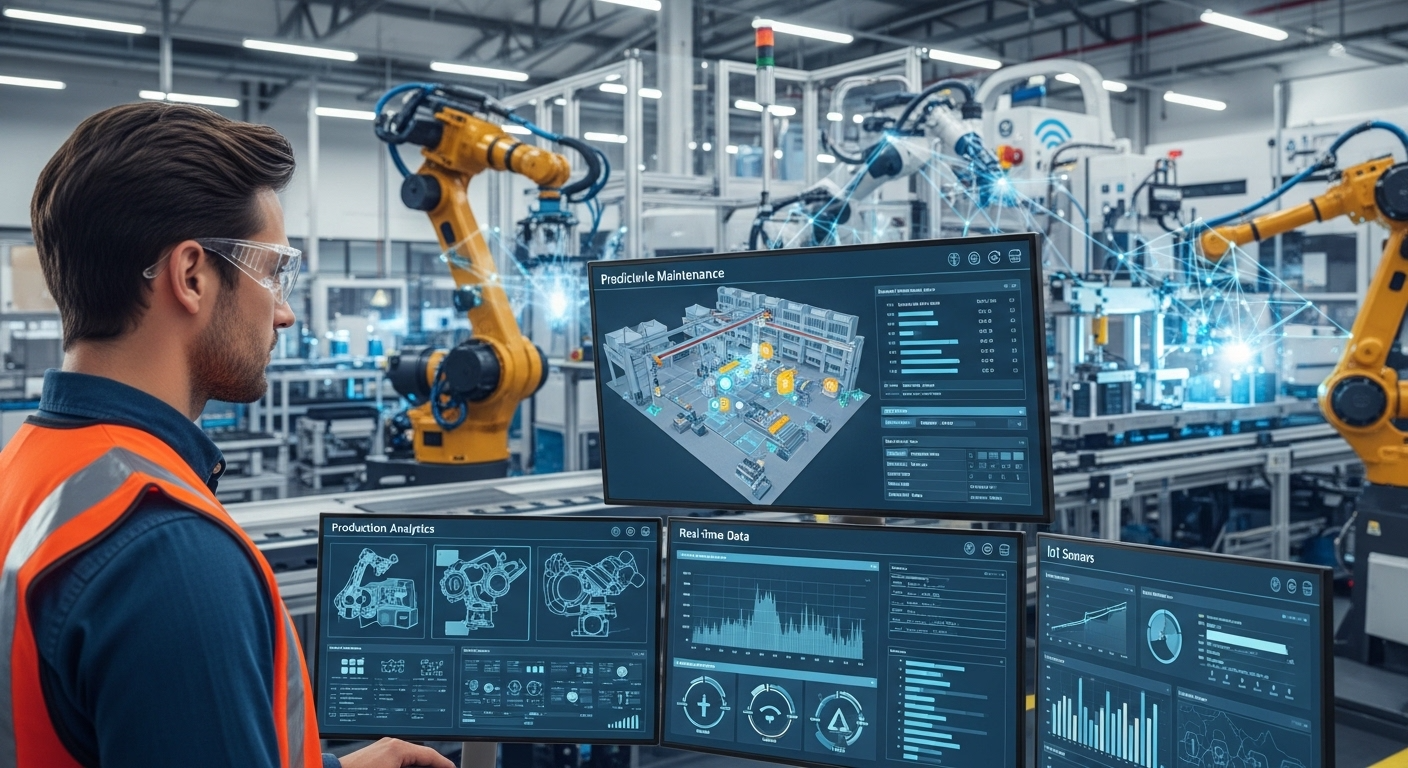
The result is the emergence of smart factories manufacturing environments where machines communicate with each other, analyze data in real time, and automatically optimize production.
2. Why Manufacturing Is Rapidly Automating
Several global trends are pushing manufacturers toward automation.
Rising Labor Costs
In many regions, labor shortages and increasing wages make manual production less competitive.
Automation helps companies maintain efficiency while reducing dependency on large workforces.
Supply Chain Resilience
The disruptions of recent years have shown that fragile supply chains can halt production.
Automated factories can operate with fewer interruptions and respond more quickly to demand changes.
Quality and Precision
Robotics and automated inspection systems significantly reduce manufacturing errors and improve product consistency.
This is especially critical in industries such as electronics, automotive, and pharmaceuticals.
Energy Efficiency
Automation systems allow manufacturers to monitor energy consumption and optimize production processes.
This improves sustainability and reduces operating costs.
3. Key Technologies Powering Smart Factories
The expansion of industrial automation is being driven by several interconnected technologies.
Industrial Robotics
Robots now handle tasks such as assembly, welding, packaging, and material handling.
Modern robots are more flexible and collaborative, allowing them to work alongside human operators.
Internet of Things (IoT)
Sensors embedded in machines continuously collect data on performance, temperature, output, and maintenance needs.
This data helps factories detect issues before equipment fails.
Artificial Intelligence
AI systems analyze production data and recommend adjustments to optimize productivity, reduce downtime, and improve forecasting.
Predictive maintenance powered by AI helps prevent costly equipment failures.
Digital Twins
Digital twins create virtual replicas of production systems.
Manufacturers can simulate operational changes before implementing them in real factories.
4. Impact on Global Supply Chains
Automation is also reshaping global manufacturing networks.
Regional Manufacturing Growth
Automation reduces the cost advantage of low-labor regions, encouraging companies to relocate production closer to end markets.
Faster Production Cycles
Automated factories can operate continuously with minimal downtime, significantly increasing output.
Supply Chain Transparency
Connected systems allow manufacturers to track materials, inventory, and production status in real time.
This improves planning and logistics coordination.
5. Workforce Transformation in Automated Manufacturing
Automation does not eliminate the need for human workers but it changes the nature of work.
New Skill Requirements
Workers increasingly need skills in:
robotics maintenance
data analysis
automation system management
software integration
Human–Machine Collaboration
Modern factories combine human expertise with machine precision.
Workers supervise automated processes, analyze performance data, and manage complex production systems.
Training and Reskilling
Companies must invest in training programs to help employees adapt to new technologies.
Workforce transformation is becoming a central part of industrial strategy.
6. Strategic Implications for Businesses
Manufacturers that successfully implement automation gain several competitive advantages.
Increased Productivity
Automated production lines can operate faster and more consistently than manual systems.
Cost Efficiency
Automation reduces operational costs over time through higher efficiency and fewer production errors.
Greater Flexibility
Smart factories can adjust production quickly in response to market demand.
Innovation Capability
Automation enables manufacturers to experiment with new production methods and product designs.
7. Consultant’s Strategic Insight
Industrial automation is not simply a technological upgrade.
It represents a fundamental shift in how manufacturing operates.
Factories are evolving from isolated production facilities into data-driven digital ecosystems where machines, analytics systems, and human operators collaborate.
The companies that succeed in this transformation will be those that:
integrate automation with enterprise data systems
invest in workforce reskilling
design production systems for flexibility and resilience
Automation is no longer optional.
It is becoming the operating system of modern manufacturing.
Executive Summary
Industrial automation is accelerating globally as manufacturers seek higher efficiency and resilience.
Robotics, IoT sensors, and AI analytics are enabling smart factories with real-time decision systems.
Automation is reducing operational costs, improving production accuracy, and addressing labor shortages.
Global investment in plant automation systems is expected to grow rapidly through the end of the decade.
Manufacturers that integrate automation with data systems will gain long-term productivity advantages.
For More Contact Me
