


Founders Are Adopting Asset-Light Scale-Up Strategies
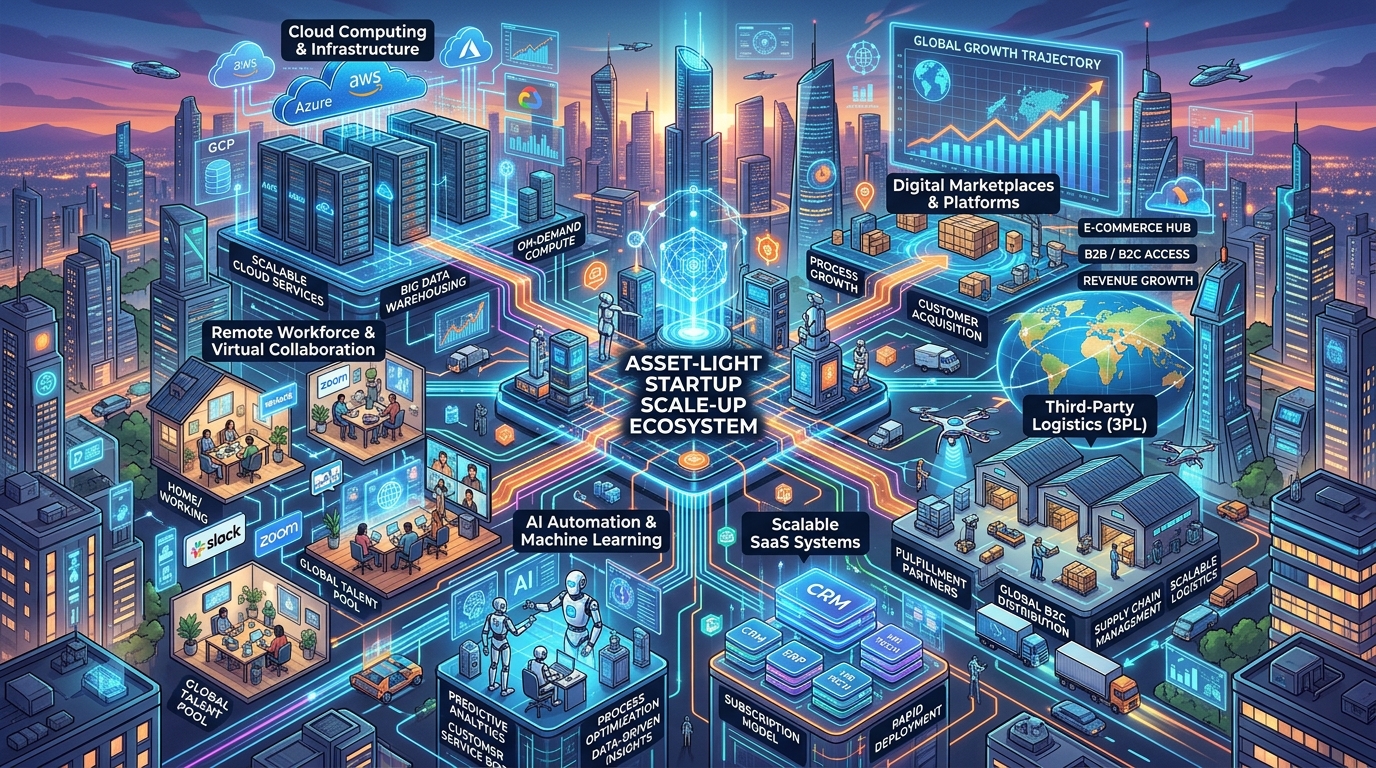
The global startup ecosystem is entering a completely new era of business building.
For more than a decade, startups were encouraged to grow aggressively, expand rapidly, hire large teams, build infrastructure, and dominate markets before competitors could catch up. Venture capital rewarded companies that prioritized speed over sustainability. The belief was simple:
“The fastest-growing company wins.”
This mindset created some of the world’s biggest technology giants, but it also created massive operational inefficiencies, unsustainable cash burn, and fragile business models that struggled when economic conditions changed.
Now, in 2026, founders are rewriting the rules of scaling.
Instead of building companies with heavy operational structures and expensive physical assets, entrepreneurs are embracing asset-light scale-up strategies leaner business models designed around flexibility, technology, automation, partnerships, and capital efficiency.
This is no longer just a startup trend.
It is becoming the preferred operating model for modern business growth.
Across industries such as:
SaaS
E-commerce
Logistics
Fintech
Manufacturing
Healthcare
Consumer brands
Hospitality
Education
Media
Professional services
founders are discovering that they can scale faster, reduce risk, and improve profitability without owning massive infrastructure.
The new generation of successful startups is proving something powerful:
“You do not need to own everything to dominate an industry.”
You only need the right systems, partnerships, technology, and execution model.
Understanding the Asset-Light Business Philosophy
An asset-light business model focuses on minimizing ownership of expensive physical assets while maximizing operational efficiency and scalability.
Rather than investing heavily in:
Buildings
Warehouses
Manufacturing plants
Vehicles
Physical retail stores
Large in-house teams
companies rely on:
Cloud infrastructure
Outsourcing
Third-party logistics
Strategic partnerships
Contract manufacturing
Digital platforms
AI automation
Remote workforces
Marketplace ecosystems
The objective is to create a business that:
Requires less capital
Scales faster
Adapts quickly
Maintains flexibility
Preserves cash flow
Generates stronger margins
This strategy allows startups to focus on their real competitive advantages:
Innovation
Branding
Customer experience
Product development
Distribution
Technology
rather than managing heavy operational infrastructure.
Why Asset-Light Models Are Dominating in 2026
The shift toward asset-light scaling did not happen overnight.
It is the result of several major global business changes that fundamentally transformed startup economics.
1. The End of “Growth at Any Cost”
One of the biggest reasons founders are adopting lean scaling strategies is the dramatic change in investor expectations.
Between 2015 and 2021, venture capital firms aggressively funded companies that prioritized rapid expansion over profitability.
Startups spent heavily on:
Hiring
Marketing
Infrastructure
International expansion
Customer acquisition
Many businesses operated at massive losses because investors believed scale alone would eventually create profitability.
But economic slowdowns, inflation, rising interest rates, and public market corrections changed investor psychology.
Today, investors ask very different questions:
Can this business survive without constant funding?
Are margins improving?
Is customer acquisition sustainable?
How efficiently is capital being used?
Can the company achieve profitability?
This has created a major operational reset inside startups.
Founders are now under pressure to:
Reduce burn rates
Improve unit economics
Increase operational efficiency
Extend runway
Build sustainable growth systems
Asset-light models naturally support these goals.
2. Technology Has Made Lean Scaling Possible
Modern technology infrastructure has dramatically reduced the need for physical ownership.
Twenty years ago, scaling a company often required:
Expensive servers
Large office spaces
Physical distribution systems
Massive operational teams
Today, startups can access world-class infrastructure instantly through cloud-based services.
A founder can now:
Launch globally using cloud computing
Operate remotely with distributed teams
Use AI agents for support operations
Outsource logistics fulfillment
Automate finance and accounting
Use no-code systems for internal workflows
Sell through digital marketplaces
Technology has essentially transformed scalability into a service.
This allows even small startups to compete globally with relatively low upfront investment.
3. Economic Volatility Requires Flexibility
The global economy remains highly unpredictable.
Businesses continue to face:
Inflation
Supply chain instability
Currency fluctuations
Labor shortages
Geopolitical risks
Regulatory uncertainty
Heavy infrastructure becomes a burden during uncertain times.
Owning factories, offices, retail chains, or large logistics fleets creates fixed costs that are difficult to reduce quickly.
Asset-light companies are more adaptable because they can:
Scale operations up or down
Shift suppliers
Enter or exit markets faster
Reduce operational liabilities
Preserve cash reserves
In uncertain environments, flexibility becomes more valuable than size.
4. AI Is Replacing Operational Complexity
Artificial intelligence is one of the biggest accelerators of lean business models.
AI allows startups to automate work that previously required entire departments.
Modern startups now use AI for:
Customer support
Sales automation
Recruitment
Marketing optimization
Data analysis
Financial forecasting
Inventory planning
Content creation
Operational reporting
This creates a major shift in scalability economics.
In the past:
More customers required more employees.
Now:
More customers require better systems.
AI enables startups to grow revenue without proportionally increasing headcount or operational complexity.
This is making asset-light models even more attractive.
The Core Principles of Asset-Light Scaling
Successful asset-light businesses usually follow several important principles.
1. Focus on Core Competencies
Instead of trying to manage everything internally, startups focus on what they do best.
For example:
A D2C brand focuses on branding and customer experience
A SaaS company focuses on software innovation
A fintech startup focuses on financial infrastructure
A logistics platform focuses on network coordination
Non-core activities are outsourced or automated.
This improves efficiency and allows teams to focus on high-value work.
2. Convert Fixed Costs Into Variable Costs
Traditional businesses often carry large fixed expenses:
Office leases
Warehousing
Manufacturing equipment
Permanent staffing
Asset-light startups aim to make costs variable instead.
This means expenses grow only when revenue grows.
For example:
Pay-per-use cloud infrastructure
Contract workers
Outsourced manufacturing
Third-party delivery networks
This creates stronger financial resilience.
3. Scale Through Partnerships
Modern startups increasingly scale through ecosystems rather than ownership.
Partnerships now drive:
Distribution
Logistics
Technology integration
Market expansion
Manufacturing
Customer acquisition
Strategic alliances help companies grow rapidly while minimizing operational burden.
4. Use Data to Optimize Operations
Asset-light businesses rely heavily on analytics and operational intelligence.
Data helps founders:
Forecast demand
Improve margins
Reduce waste
Optimize marketing
Increase retention
Improve customer experience
The more digital the business model becomes, the more measurable and scalable operations become.
Popular Asset-Light Scaling Models
Different industries apply asset-light principles differently.
Franchise-Based Expansion
Many startups are adopting franchise systems to scale geographically.
Instead of directly funding every location, entrepreneurs partner with local operators.
Benefits include:
Faster expansion
Reduced capital expenditure
Lower operational risk
Better local market understanding
Industries using franchise models include:
Food chains
Healthcare
Fitness
Education
Retail
Hospitality
Marketplace Platforms
Marketplace companies are among the most successful asset-light businesses in the world.
These businesses connect:
Buyers and sellers
Service providers and consumers
Businesses and freelancers
without owning the underlying inventory or infrastructure.
Examples include:
E-commerce marketplaces
Ride-sharing platforms
Food delivery apps
Freelance platforms
Travel aggregators
Their biggest advantage is scalability through network effects.
Contract Manufacturing
Consumer startups increasingly avoid building factories.
Instead, they work with manufacturing partners while focusing internally on:
Product design
Branding
Marketing
Community building
Customer acquisition
This model is common among:
Fashion brands
Electronics startups
Cosmetics companies
Nutrition brands
Consumer packaged goods businesses
Remote-First Organizations
The rise of distributed workforces has become one of the strongest asset-light transformations in modern business.
Remote-first startups benefit from:
Lower infrastructure costs
Global hiring access
Improved flexibility
Reduced geographic limitations
Many startups now operate globally without maintaining expensive headquarters.
Cloud-Native SaaS Businesses
Software startups are among the purest forms of asset-light companies.
Cloud-native SaaS businesses can scale internationally without:
Physical stores
Warehouses
Distribution networks
Large operational infrastructure
Their primary assets are:
Software
Intellectual property
Data
Customer relationships
This creates extremely scalable economics.
The Financial Advantages of Asset-Light Scaling
The financial benefits are one of the biggest reasons founders prefer these models.
Higher Capital Efficiency
Less infrastructure means lower upfront investment.
This allows startups to:
Extend runway
Reduce fundraising pressure
Reach profitability faster
Improved Return on Investment
Asset-light companies often generate better returns because they avoid heavy capital expenditures.
Investors increasingly favor businesses with:
Strong margins
Efficient operations
Scalable systems
Better Cash Flow Management
Heavy infrastructure consumes cash continuously.
Lean businesses preserve liquidity and can redirect capital toward:
Innovation
Marketing
Product development
Expansion opportunities
Faster Market Entry
Without needing physical infrastructure, startups can launch in new markets rapidly.
This speed creates competitive advantages.
Challenges of Asset-Light Models
While asset-light strategies offer many benefits, they also create new challenges.
Dependence on Third Parties
Outsourcing operations increases reliance on external partners.
Poor vendor performance can damage customer experience.
Reduced Operational Control
Companies may have less control over:
Quality standards
Delivery timelines
Operational consistency
Strong governance systems become essential.
Brand Reputation Risks
If third-party partners fail operationally, customers often blame the brand itself.
Maintaining standards across partnerships becomes critical.
Increased Competition
Since startup costs are lower, barriers to entry also decrease.
This makes differentiation more important than ever.
Industries Being Transformed by Asset-Light Models
E-Commerce
Brands increasingly use:
Third-party fulfillment
Marketplace distribution
Dropshipping
Digital marketing automation
Healthcare
Telemedicine and diagnostics partnerships are reducing infrastructure dependency.
Fintech
Digital banking and embedded finance models operate with minimal physical branches.
Education
Online learning platforms scale globally without traditional campuses.
Hospitality
Many travel brands now operate through aggregation rather than ownership.
Manufacturing
Smart supply chains and contract production are redefining industrial scalability.
Founder Mindset Is Also Changing
Asset-light scaling is not only an operational shift.
It is also a psychological shift.
Modern founders are becoming:
More disciplined
More data-driven
More efficiency-focused
More operationally strategic
The new generation of entrepreneurs understands:
Bigger teams do not always mean better companies
More infrastructure does not guarantee stronger businesses
Sustainable growth is more valuable than reckless expansion
This represents a major maturity shift within the startup ecosystem.
The Future of Startup Scaling
The future of business growth will likely be defined by:
AI-driven automation
Platform ecosystems
Lean operations
Flexible infrastructure
Strategic partnerships
Digital scalability
The most successful startups of the next decade may own fewer physical assets than traditional companies, yet generate significantly higher efficiency and profitability.
The winners will be businesses that can:
Adapt quickly
Scale intelligently
Preserve cash
Automate operations
Build strong ecosystems
Deliver consistent customer value
Final Thoughts
The rise of asset-light scale-up strategies is one of the biggest transformations happening in the startup world today.
Founders are no longer obsessed with building massive operational empires filled with expensive infrastructure and oversized teams.
Instead, they are focusing on:
Agility
Efficiency
Technology
Automation
Partnerships
Sustainable growth
This new business philosophy is creating companies that are:
Faster
Leaner
Smarter
More resilient
More scalable
In 2026, success is no longer measured by how many assets a company owns.
It is measured by:
How efficiently it operates
How intelligently it scales
How resiliently it survives uncertainty
And how effectively it creates long-term value
The startups that master asset-light scaling may ultimately become the strongest businesses of the next generation.
