


AI Investment Boom Is Reshaping Global Markets
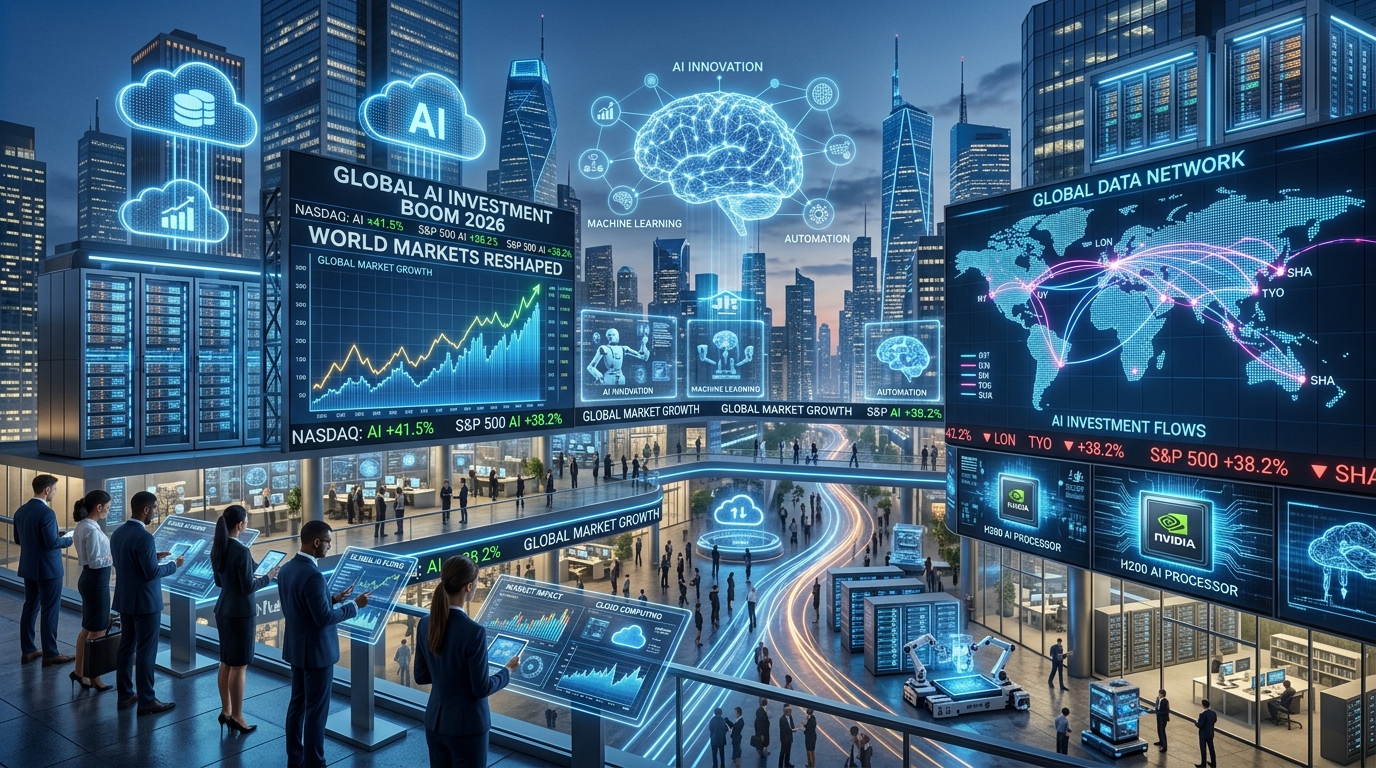
Artificial Intelligence has rapidly evolved from a futuristic innovation into one of the most influential economic forces in modern history. In 2026, AI is no longer just improving software systems or automating repetitive tasks it is fundamentally reshaping global markets, transforming industries, influencing government policies, and redefining the future of work.
Across the world, businesses are investing billions of dollars into AI technologies to gain competitive advantages, improve operational efficiency, reduce costs, and unlock new revenue streams. At the same time, investors are aggressively pouring capital into AI-driven companies, believing that AI could become one of the most valuable technological revolutions since the internet.
The impact of AI investment is visible everywhere:
Stock markets are heavily influenced by AI-related companies
Semiconductor demand is reaching record highs
Governments are competing for AI leadership
Data center construction is accelerating worldwide
Companies are restructuring operations around automation
Global labor markets are evolving rapidly
This AI investment boom is not a temporary financial trend. It is a global economic transformation that is changing how businesses operate and how markets behave.
The Evolution of Artificial Intelligence in Business
Artificial Intelligence was once considered an experimental technology limited to research institutions and advanced tech companies. However, over the last decade, improvements in:
Computing power
Machine learning algorithms
Cloud infrastructure
Big data analytics
Natural language processing
have made AI commercially practical for businesses of all sizes.
Today, AI is integrated into:
Customer service platforms
Financial systems
Manufacturing processes
Marketing automation
Supply chain management
Healthcare diagnostics
Cybersecurity tools
E-commerce platforms
Organizations now use AI to analyze massive amounts of data, predict future trends, automate complex workflows, and improve decision-making in real time.
As a result, AI is becoming the backbone of modern digital transformation strategies.
Why the AI Investment Boom Is Happening
The global rush toward AI investment is driven by several powerful economic and competitive factors.
1. Businesses Want Greater Efficiency
One of the biggest reasons companies invest in AI is operational efficiency.
AI systems can:
Process information faster than humans
Automate repetitive tasks
Reduce manual labor
Improve accuracy
Operate continuously without fatigue
This allows businesses to lower operating costs while increasing productivity.
For example:
Retail companies use AI for inventory management
Banks use AI for fraud detection
Manufacturers use AI for predictive maintenance
Healthcare providers use AI for diagnostics
Logistics companies use AI for route optimization
The potential savings are enormous, making AI investment highly attractive to executives and investors alike.
2. AI Creates New Revenue Opportunities
AI is not only reducing costs it is also generating entirely new business models.
Companies are monetizing AI through:
Subscription-based AI tools
AI-powered customer platforms
Intelligent automation services
Personalized advertising systems
AI assistants and copilots
Predictive analytics products
Businesses that successfully integrate AI into their products can scale faster and serve customers more efficiently.
This has created intense competition among corporations to launch AI-powered services before their competitors.
3. Investors Believe AI Will Drive Long-Term Economic Growth
Global investors see AI as a transformative technology capable of reshaping entire economies.
Many analysts compare the AI revolution to:
The industrial revolution
The rise of electricity
The internet boom
The smartphone era
Investors believe AI could dramatically improve:
Global productivity
Corporate profitability
Innovation speed
Consumer experiences
Economic output
As a result, institutional investors, venture capital firms, hedge funds, and sovereign wealth funds are increasing their exposure to AI-related assets.
AI Is Reshaping Global Stock Markets
One of the clearest signs of the AI investment boom is its enormous influence on financial markets.
Technology companies involved in AI development have become some of the most valuable corporations in the world. Investors are aggressively buying shares in businesses associated with:
AI software
Semiconductors
Cloud computing
Robotics
Data infrastructure
Automation systems
This concentration of investment has pushed technology indexes higher across global markets.
In many countries, AI-related companies are now responsible for a large percentage of overall stock market growth.
Semiconductor Companies Are Becoming Market Giants
AI systems require extraordinary computing power. This has made semiconductor manufacturers some of the most strategically important companies in the global economy.
Advanced AI models depend on powerful chips capable of processing massive amounts of data quickly and efficiently.
Because of this demand:
Chip shortages have become common
Semiconductor factories are expanding globally
Governments are funding domestic chip production
Supply chains are being restructured
Countries now view semiconductor independence as a matter of economic security and national competitiveness.
The semiconductor industry has become the foundation of the AI economy.
The Global Race to Build AI Infrastructure
AI cannot function without large-scale infrastructure. As AI adoption grows, businesses and governments are investing heavily in:
Data centers
High-performance computing systems
Cloud networks
Fiber connectivity
Renewable energy systems
Massive AI models require enormous computational resources, creating a surge in infrastructure spending worldwide.
Tech companies are building giant AI campuses containing thousands of servers capable of training advanced AI systems.
This infrastructure race is benefiting multiple industries:
Construction
Real estate
Energy
Telecommunications
Industrial equipment manufacturing
The expansion of AI infrastructure is creating ripple effects throughout the global economy.
Data Centers Are Becoming the New Economic Powerhouses
Data centers are now among the most critical assets in the digital economy.
AI applications require:
Massive storage capacity
Advanced cooling systems
Continuous power supply
Ultra-fast networking
As AI workloads increase, demand for data centers is exploding.
Large technology companies are investing billions into:
AI supercomputers
Specialized AI servers
Cloud expansion projects
Global network infrastructure
This trend is also increasing demand for electricity, leading to renewed investment in:
Renewable energy
Nuclear energy
Smart power grids
Energy storage systems
Energy providers are now adapting to support the growing power requirements of AI infrastructure.
AI Is Transforming the Global Workforce
The AI boom is dramatically changing labor markets worldwide.
Automation of Repetitive Work
Many repetitive and administrative tasks are becoming automated through AI systems.
Industries experiencing automation include:
Customer support
Accounting
Data processing
Manufacturing
Logistics
Retail operations
This allows companies to improve efficiency while reducing manual workloads.
Rising Demand for Digital Skills
At the same time, AI is creating enormous demand for skilled professionals such as:
AI engineers
Data scientists
Cybersecurity analysts
Cloud architects
Machine learning specialists
Automation consultants
Businesses are competing aggressively for top AI talent.
Universities and governments are now investing heavily in AI education and workforce training programs.
Workforce Reskilling Is Becoming Essential
As AI changes job requirements, companies are increasingly focused on reskilling employees.
Organizations are training workers in:
AI tools
Data analysis
Automation systems
Digital collaboration platforms
Workforce adaptability is becoming one of the most important business survival factors in the AI era.
AI Is Changing Global Competition
Artificial Intelligence has become a major geopolitical priority.
Governments worldwide understand that AI leadership could determine:
Economic power
Military strength
Technological influence
Global competitiveness
Countries are investing heavily in:
AI research
Semiconductor production
National AI strategies
Digital infrastructure
Technology startups
The competition between major economies is intensifying, particularly in:
Semiconductor manufacturing
Cloud computing
Robotics
Defense AI systems
AI is increasingly influencing international trade policies and global alliances.
Industries Experiencing Massive AI Transformation
Healthcare
AI is revolutionizing healthcare through:
Faster diagnostics
Drug discovery
Personalized treatment plans
Medical imaging analysis
Predictive healthcare systems
Hospitals and pharmaceutical companies are investing heavily in AI-powered research tools.
Finance
Financial institutions use AI for:
Fraud prevention
Risk analysis
Trading automation
Customer insights
Portfolio management
AI allows banks and investment firms to process financial data more efficiently and accurately.
Retail & E-Commerce
Retailers use AI to:
Predict customer behavior
Optimize inventory
Improve recommendation systems
Personalize marketing campaigns
Automate customer support
AI-driven personalization is becoming essential for online businesses.
Manufacturing
Factories are becoming smarter through AI-powered automation systems.
Manufacturers use AI for:
Predictive maintenance
Robotics control
Supply chain optimization
Quality inspection
Energy efficiency
This improves production speed and reduces operational downtime.
Risks and Challenges Behind the AI Boom
Despite enormous opportunities, the AI investment boom also creates serious challenges.
1. Risk of an AI Market Bubble
Some analysts worry that AI company valuations may become excessively inflated.
If investor expectations become unrealistic, markets could face:
Stock price corrections
Investment losses
Reduced market confidence
This concern is similar to fears seen during previous technology bubbles.
2. Rising Infrastructure Costs
AI infrastructure requires massive financial investment.
Businesses are spending billions on:
Chips
Servers
Cloud systems
Data centers
Energy infrastructure
Not every AI investment will produce profitable returns.
3. Ethical and Regulatory Concerns
Governments are introducing new AI regulations related to:
Data privacy
Copyright issues
Ethical AI use
Algorithm transparency
Cybersecurity risks
Regulatory uncertainty may affect how companies develop and deploy AI technologies.
4. Energy and Environmental Pressure
AI systems consume enormous amounts of electricity.
As AI infrastructure expands, concerns are growing about:
Carbon emissions
Power shortages
Sustainability challenges
This is increasing interest in renewable energy solutions for AI operations.
How Businesses Are Preparing for the AI Future
To remain competitive, companies are rapidly adapting to the AI economy.
Businesses are:
Increasing AI budgets
Hiring AI specialists
Partnering with technology firms
Automating operations
Investing in cloud infrastructure
Modernizing cybersecurity systems
Executives increasingly believe that companies failing to adopt AI may struggle to survive in future markets.
AI transformation is becoming a core part of long-term business strategy.
The Long-Term Economic Impact of AI
Experts believe AI could become one of the most influential technologies in economic history.
Potential long-term impacts include:
Higher global productivity
Faster innovation cycles
Improved healthcare systems
Smarter transportation networks
More efficient governments
Advanced scientific discovery
However, the future impact of AI will depend on how societies manage:
Regulation
Workforce transitions
Ethical concerns
Economic inequality
Technology concentration
The decisions made today will shape how AI influences future generations.
Conclusion
The AI investment boom is transforming global markets at an unprecedented pace. What began as a technological innovation has evolved into a worldwide economic revolution affecting businesses, governments, investors, workers, and consumers alike.
From semiconductor manufacturing and cloud computing to labor markets and geopolitical competition, AI is reshaping the structure of the modern global economy.
Businesses that embrace AI strategically may unlock extraordinary opportunities for growth, efficiency, and innovation. Meanwhile, organizations that fail to adapt risk becoming irrelevant in an increasingly AI-driven world.
The AI era is no longer a prediction about the future it is already happening. The global economy is entering a new phase where Artificial Intelligence will play a central role in determining market leadership, economic power, and long-term business success.
